
Andrea Geipel

COLORING AND WORKBOOK
With a foreword by Prof. Dr. Dagny Holle-Lee!
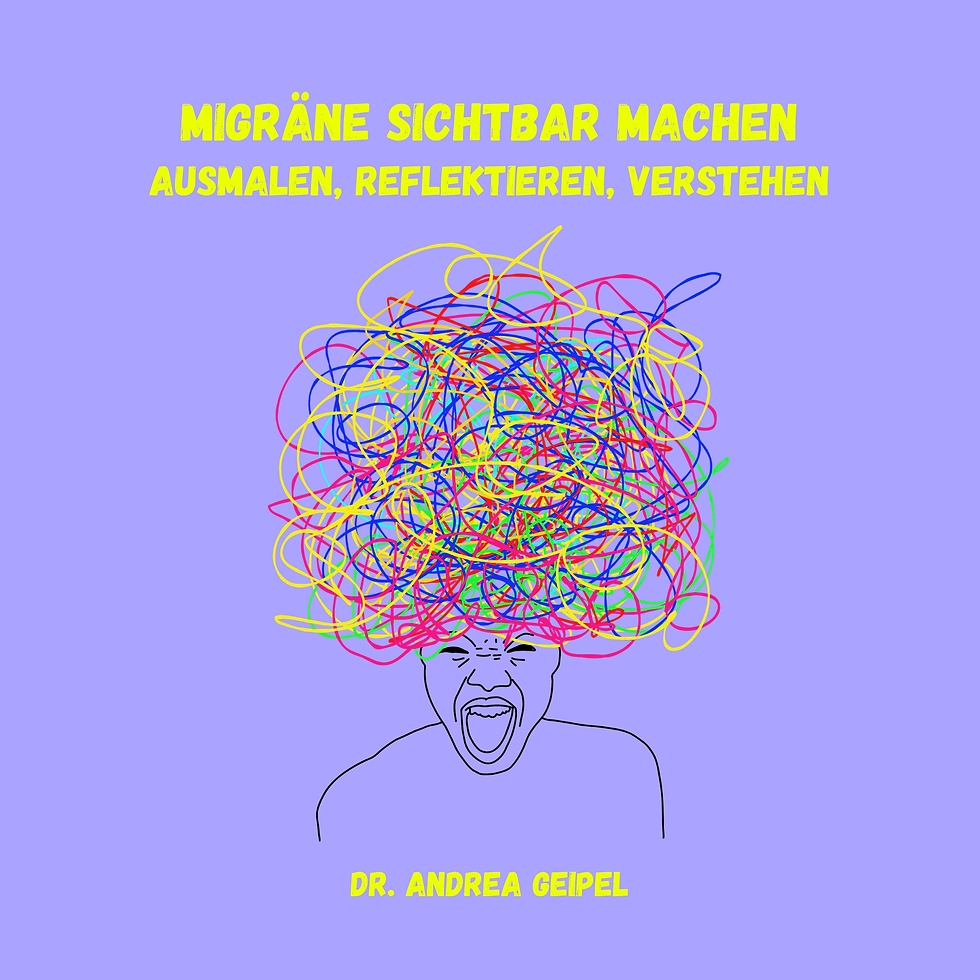
"Making Migraine Visible" is an artistic-medical coloring and activity book for people with migraines.
It combines creative design, reflection and understandable medical information into an easily accessible tool for everyday life with chronic pain.
The book straddles the line between art, science communication, and self-help. It is neither a traditional coloring book nor a medical guide, but rather an open format that supports those affected by migraine in making their condition visible and reflecting on their own experiences.
The exercises range from simple doodles during mild attacks to visual pain scales and reflection and learning formats on neurobiology, triggers, and self-care. The focus is not on performance or "correct" drawing, but on perception, expression, and making individual experiences visible.
The result is a book that combines medical knowledge with artistic practice and opens up new possibilities for talking about migraine – with oneself, with relatives or in a medical context.
LOOK INSIDE THE BOOK


Click on the images to view them in full size.
WHAT'S INSIDE?
The coloring book invites you to be active with your hands without pressure or expectations – anywhere and anytime. It's not about coloring beautifully or creating something perfect, but about accepting an activity that suits you in the moment.
Forget perfection: Here, lines can wobble, colors can run, pages can be crossed out or scribbled on. The pocket attached to the spine keeps your pens and pencils close at hand – whether colored pencils, graphite pencils, or a ballpoint pen. All that matters is having something in your hand that allows for repetitive movements: circling, hatching, filling in. Sometimes even without looking, from the sofa, during a mild burst of inspiration – let go and gently shift your focus elsewhere.
Each page is a suggestion that you can use, ignore, or repurpose:
-
DODDLING : Doodling when frustrated, repetitive patterns for calm, mindfulness pictures or simply drawing freely.
-
REFLECTION : Find your migraine colors and shapes, visualize the pain; note what helps or bothers you.
-
LEARNING : Coloring in brains, blood vessels or neurons – internalizing visually, without text overload.
-
BEFORE THE APPOINTMENT : Your pain scale, making your pain visible and recording changes.
-
GOOD PAGES : Celebrate successes, record good things, and visualize positive quotes.
Use the book sometimes, always, or not at all – try out what works for you. Cross out silly comments, prepare for doctor's appointments, make your migraine visible to others. If pain triggers the fear of "not being able to cope," start small, with a single line. It doesn't replace treatment, but creates space for relief, understanding, and a little resistance. The book remains your companion – flexible, uncomplicated, and without pressure to perform.
WHAT'S BEHIND IT?
Creative activities can influence pain perception through various mechanisms:
-
Distraction and redirecting attention: When the brain is occupied with tracing lines, choosing colours or repeating patterns, attention is temporarily directed towards another activity. This does not make the pain go away, but it can cause it to recede into the background for a moment. A recent review article on the role of visual art therapy in migraine describes distraction, an altered perception of pain and psychosocial relief as possible contributing factors. At the same time, the authors emphasise that research specifically on migraine is still limited (Smirnoff & Pham, 2024).
-
Managing stress and emotions: Art can help to give visible form to feelings of powerlessness, anger or being overwhelmed. Things that were previously difficult to grasp or put into words take on lines, colours and shape. This can help people to recognise and express their inner tension. A review of art therapy approaches for chronic pain reports improvements in pain, mood, stress and quality of life in the majority of the studies included – though it also highlights the varying quality and methodology of the studies (Raudenská et al., 2023; Barnett & Vasiu, 2024).
-
Visualization and communication: Painting one’s own pain can help to make one’s experiences visible and thus easier to talk about – particularly when the right words are lacking during an attack. A picture can serve as a starting point for discussions with doctors or therapists. Art therapy is explicitly described in the literature as a non-verbal form of expression through which feelings, desires and experiences can be expressed (Barnett & Vasiu, 2024). Furthermore, visualisations of one’s own pain can provide valuable insights into the emotional world of those affected by pain conditions and positively influence communication between doctors and patients (Philips et al., 2015; Ali et al., 2025).
-
Visualization and learning: Colouring in brain structures, blood vessels or possible pathological processes can make medical information more accessible. In this way, it may be easier to understand certain relationships and link them to one’s own experiences. However, there has so far been only limited direct research into the specific combination of colouring and knowledge of migraine. The book’s educational function should therefore be understood as a plausible pedagogical approach rather than a scientifically proven therapeutic effect. Note that, Schmeck et al (2014) demonstrated in a study that drawing pictures can positively support learning among schoolchildren.
Some of the exercises in this book are based on the principles of biofeedback, which is also used in the treatment of migraine (Nestoriuc & Martin; 2007). Biofeedback involves consciously perceiving physical signals – such as muscle tension, skin temperature or heart rate – and, where possible, influencing them. The aim is to support the body’s own regulatory processes, for example through rest, breathing and relaxation. Biofeedback is also recommended as a non-pharmacological approach in the current guidelines for the treatment and prevention of migraine (Diener et al, 2025).
Colouring in blood vessels, brain structures or pain pathways is not biofeedback in the technical sense, as no physiological parameters are measured. However, it can be used as a visual exercise to support body awareness, breathing and self-observation. Rather, the exercises draw on specific principles: the conscious awareness of one’s own body, linking sensations with images, and focusing on calm, repetitive movements.
For example, by colouring in blood vessels, brain structures or pain pathways, you can try to
-
become more aware of your body: How does my head feel right now?
-
to link inner sensations with external images, colours and shapes,
-
to observe your breathing and the pace of your movements,
-
to find a calm, repetitive rhythm for as long as it feels comfortable and manageable.
This is not a substitute for medical or therapeutic treatment and does not constitute a promise of a cure. However, it can serve as a small, self-directed space for practice – a visual notebook for your own mind, in which there is room for knowledge, body awareness and feelings.
Literature Ali SM, Elsayed S, Lee RR, et al. (2025) Clinical utility of digital pain drawings captured by people living with musculoskeletal pain conditions: a qualitative study. British Journal of Pain. 19(5):326-336. doi: https://doi.org/10.1177/20494637251343227. Barnett K. S. and Vasiu F. (2024) How the arts heal: a review of the neural mechanisms behind the therapeutic effects of creative arts on mental and physical health. Front. Behav. Neurosci. 18:1422361. doi: https://doi.org/10.3389/fnbeh.2024.1422361. Diener H.-C., Förderreuther S, Kropp P., Reuter U. et al. (2025) Therapie der Migräneattacke und Prophylaxe der Migräne, S1-Leitlinie, 2025, DGN und DMKG, in: Deutsche Gesellschaft für Neurologie (Hrsg.), Leitlinien für Diagnostik und Therapie in der Neurologie. Online: www.dgn.org/leitlinien (abgerufen am 14.08.2026) Nestoriuc, Y. & Martin, A. (2007) Efficacy of biofeedback for migraine: A meta-analysis, Pain, Volume 128, Issues 1–2, Pages 111-127, doi: https://doi.org/10.1016/j.pain.2006.09.007. Phillips J, Ogden J, Copland C. (2015) Using drawings of pain-related images to understand the experience of chronic pain: A qualitative study. British Journal of Occupational Therapy. 78(7):404-411. doi: https://doi.org/10.1177/0308022614562791. Raudenská, J., Šteinerová, V., Vodičková, Š. et al. (2023). Arts Therapy and Its Implications in Chronic Pain Management: A Narrative Review. Pain Ther 12, 1309–1337. doi: https://doi.org/10.1007/s40122-023-00542-w. Schmeck, A.; Mayer, R.E., Opfermann, M.; Pfeiffer, V. & Leutner, D. (2014) Drawing pictures during learning from scientific text: testing the generative drawing effect and the prognostic drawing effect. Contemporary Educational Psychology, Volume 39, Issue 4, Pages 275-286, doi: https://doi.org/10.1016/j.cedpsych.2014.07.003. Smirnoff, L., Pham, K. A. (2024). Role for Visual Art Therapy in the Management of Migraine. Curr Pain Headache Rep 28, 189–194. doi: https://doi.org/10.1007/s11916-023-01207-1.
FACTS
Working title:
Making migraines visible - coloring · reflecting · understanding
A coloring and activity book for people with migraines
Author: Dr. Andrea Geipel
With a foreword by Prof. Dr. Dagny Holle-Lee
Brief description:
“Making Migraines Visible” is an artistic-medical coloring and activity book for people with migraine. It combines creative design, reflection, and easily understandable medical information into a low-threshold tool for everyday life with chronic pain.
This book is neither a traditional coloring book nor a medical guide, but rather a hybrid format combining art, science communication, and self-help. It supports those affected by migraine in visualizing their experience, better understanding themselves, and expressing their experiences – including within a medical context.
Why this book now?
Migraine affects approximately 15% of the population and is one of the most common neurological disorders worldwide. Despite new therapeutic developments, many sufferers continue to experience stigmatization, a lack of understanding, and significant distress in their daily lives. At the same time, there is a growing desire for accessible health information, empowerment, and new approaches beyond traditional self-help literature. Creative, hands-on formats are gaining importance, particularly for those with chronic conditions—both for emotional relief and for improving communication with medical professionals. "Making Migraine Visible" addresses this need and translates medical knowledge into images, forms, and creative strategies.
Scope & Features:
-
approx. 120–150 pages
-
Format approx. 22 × 20 cm
-
Work-friendly binding (e.g. spiral or lay-flat binding)
-
sturdy paper (approx. 120 g/m²)
-
Optional extras: removable postcards
WHERE CAN YOU FIND IT?
I'm looking for a publisher!
"Making migraines visible – coloring · reflecting · understanding" is not yet available in stores.
The prototype is finished – now I am looking for a publisher or suitable partners to help me launch the book.
You still want to take a look inside?
You can view the book until September in the exhibition “ Stimulus Spaces ” at the Waterkant Festival in Kiel.
Are you interested in the book?
Then you can support the project right now:
📩 Do you have a contact at a suitable publisher, foundation, or other potential partner? I would be very grateful for any tips and recommendations.
Feel free to write to me via the contact form or by email .
💌 Would you like to own the book yourself?
Then send me a short email to express your interest. The more people who are interested in the book, the better I can demonstrate to publishers and potential partners that there is a demand for this format.
Express interest in the book.
A short message is all it takes – you are under no obligation.
It is still unclear how and when the book will be published –
But the story continues.