Andrea Geipel

KOPFLAND SCHAFTEN
An artistic approach to migraine.
KOPFLANDSCHAFTEN (Headscapes) combined art, science communication, and participatory research to create an open experiential space about migraine. Between June 3 and 13, 2026, 156 people visited the exhibition at the Pop-up Pavilion in Kiel. This page documents the exhibition and provides insights into the accompanying program and research stations.
Contents: About the exhibition · Impressions · Sound pieces · Community art · Accompanying research · Blog · Press and media · Partners

“There are experiences that are almost impossible to put into words – pain is one of them. That is precisely why art can sometimes convey more than any scientific explanation. This exhibition makes the invisible visible and, in a powerful way, fosters understanding and empathy for people with migraine. It made a deep impression on me."
Prof. Dr. Dagny Holle-Lee
ABOUT THE EXHIBITION
KOPFLANDSCHAFTEN was a participatory, multidisciplinary exhibition about migraine as a complex neurological disorder. It combines art, science communication, and participatory research into an open experiential space for sufferers and non-sufferers alike.
In collages, drawings, sculptures, and installations, inner spaces of perception such as pain, sensory overload, loss of time, and withdrawal were translated into visual images. The works were complemented by interactive research stations and the participatory puzzle "Lautstücke" (Sound pieces) which was created during the exhibition in collaboration with people suffering from migraines.
The works were shown Unter Druck, equipped , Im Rahmen der Möglichkeiten, Chron[olog]ic , Erlöse uns... , Ferita d'Oro , Freigelegt , 2.818 , Lautstücke , (UN)GESEHEN and in:visible .
ACCOMPANYING PROGRAM


Opening ( June 2, 2026)
The opening took place as part of the Action Day Against Pain and was also accompanied by an Instagram Live broadcast with Prof. Dagny Holle-Lee and Dennis Israel. In addition to the guests present, around 80 people followed the opening online.
Lecture "Migraine: The Grammar of Pain" ( June 9, 2026)
Prof. Dr. Janne Gierthmühlen (UKSH) spoke about the current state of research on migraine, the development of pain, and the influence of biopsychosocial factors. Afterwards, there was an opportunity for questions and discussion.
Discussion round ( June 11, 2026)
Together with Prof. Dr. Hartmut Göbel, Ute Diez, Ann-Christin Hoeltje and Andrea Geipel, Dorothe Knapp discussed art, migraine and science communication with the panel, as well as the role of artistic projects for visibility and destigmatization of chronic diseases.
Closing event (June 13, 2026)
At the close of the exhibition, the participatory puzzle "Lautstücke" was presented, and an initial review of the exhibition and the accompanying research was given. The strong response demonstrated the importance of spaces for exchange and visibility surrounding the topic of migraine.
IMPRESSIONS

Foto Sibbe Media


Foto Sibbe Media
Foto Sibbe Media
Click on the images to view them in full size.
PARTICIPATORY PUZZLE
LAUTSTÜCKE
“Lautstücke” is a participatory puzzle artwork.
The 22 puzzle pieces are based on terms, images, poems, and personal experiences of people with migraine. Each submission was artistically translated into a unique puzzle piece. Together, they don't form a single, unified picture, but rather a diverse collection of individual perspectives on migraine.
The work is accompanied by the archive "Sound Pieces from Migraine", which documents the submitted words and texts.
The puzzle makes visible what the exhibition as a whole is concerned with: migraine is not a single experience, but many different realities.
You can find more information about the artwork in the portfolio.
 Lautstücke - Stand 1. Woche |  Puzzlestück Nr. 8 |
|---|---|
 Begriffe Puzzlestück Nr. 8 |  Puzzlestück Nr. 9 |
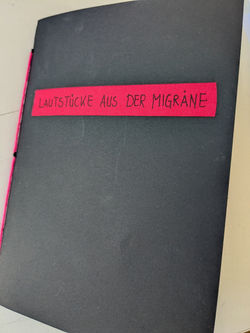 Begleitheft Lautstücke aus der Migräne |  Puzzlestück Nr. 12 |
 Einreichung einer Betroffenen im Begleitheft | 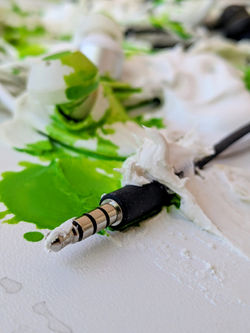 Puzzlestück Nr. 14 |
 Begriffe Puzzlestück Nr. 14 |  Puzzlestück Nr. 15 |
 Puzzlestück Nr. 16 | 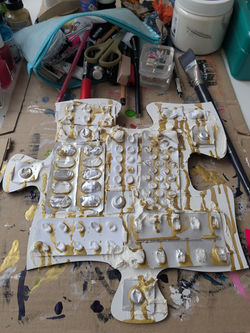 Puzzlestück Nr. 17 |
 Einreichung einer Betroffenen im Begleitheft |  Puzzlestück Nr. 18 |
 Eingereichtes Gedicht zum Puzzlestück Nr. 18 |  Puzzlestück Nr. 19 |
 Puzzlestück Nr. 20 |  Begriffe Puzzlestück Nr. 20 |
 Puzzlestück Nr. 22 |  Lautstücke |
Click on the images to view them in full size.
COMMUNITY GALLERY
Your migraine as a work of art
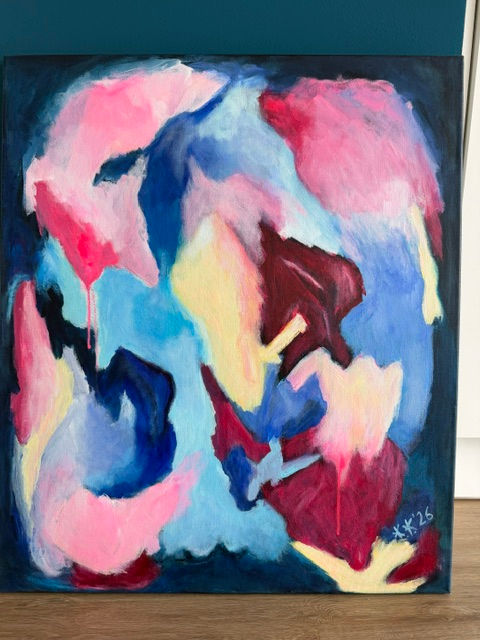
Einreichung von Karin Zobel
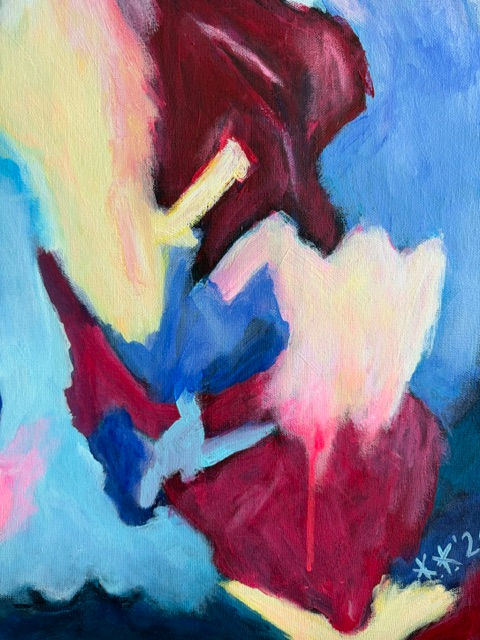
Einreichung von Karin Zobel

Einreichung von Marko Herzog
Einreichung von Karin Zobel
Click on the images to view them in full size.
Migraine is often perceived as an individual experience. At the same time, many sufferers share similar challenges, questions, and feelings.
As part of KOPFLANDSCHAFTEN, people with migraine were invited to submit their own artistic works. The result is a digital gallery featuring drawings, photographs, paintings, texts, and mixed-media works by various artists and migraine sufferers.
The collection reveals the diverse ways in which migraines are experienced and artistically processed. It complements the exhibition with perspectives that extend beyond the artist's own experiences, creating a space for exchange, recognition, and new viewpoints.
The online gallery continues to grow and sees itself as an open archive of artistic voices on migraine.
ACCOMPANYING RESEARCH
KOPFLANDSCHAFTEN combines art with science communication and participatory research.
During the exhibition, visitors were invited to participate at various interactive stations.
-
What do you know about migraines? - Highlight and reflect on your knowledge
-
Body map - Where do you feel migraine?
-
Dialogue Wall - Ask questions and get answers
-
Whisper Box - What you've always wanted to say.
The stations served to stimulate conversations between those affected and those not affected, and to highlight different perspectives on migraine.
The collected contributions form the basis for the evaluation of the exhibition and are intended to provide initial indications of how art can contribute to conveying knowledge about migraine, reducing prejudices and promoting social dialogue.
The evaluation of the contributions forms the basis for a further research project on the influence of participatory art on science communication and destigmatization of chronic diseases.
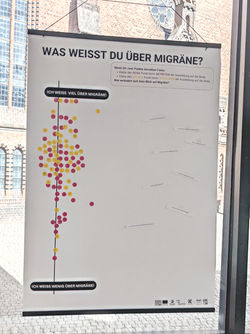 What do you know about migraine?Before-and-after comparison |  Conversation WallAsk questions and get answers. |  Where do you feel migraine?Finding colours and become visible. |
|---|---|---|
 WhisperboxWhat is it you always wanted to talk about? |
Click on the images to view them in full size.
What remains of the exhibition.
Knowledge Graph – “What do you know about migraine?”
Visitors were asked to place a dot on a scale ranging from “I know little about migraine” to “I know a lot about migraine” both when entering and when leaving the exhibition.
The digitised analysis identifies 60 numbered participants. Ten people marked only the first point. Among the pairs that could be reliably matched, the clearly legible cases show a distinct tendency towards a higher self-assessment at the end of the exhibition visit.
The graph does not measure objective medical knowledge. Rather, it shows how visitors assess their own knowledge and whether this assessment changes over the course of their visit to the exhibition.
Body map – ‘Where do you feel your migraine?’
On a silhouette of the body, those affected could mark where they themselves experience migraine. Those not affected were invited to mark where they suspect migraine occurs.
The resulting collective drawing shows a high concentration of markings in the head area, but at the same time numerous markings on the face, neck, shoulders, torso, arms and legs. Different colours, lines, dots, spirals, shapes and symbolic forms highlight the diversity of the representations.
What struck many visitors in particular was that, on the map, migraine did not appear exclusively in the head. As a result, the body map repeatedly served as a starting point for discussions about the complexity of the condition.
Question Wall
The Question Wall was used, but significantly less frequently than the body map. The questions related, amongst other things, to the definition and causes of migraine, hormonal migraine, coping with the condition in everyday life, and experiences of not being understood.
The few contributions nevertheless cover a broad spectrum: from medical questions to very personal statements about loneliness, insecurity and the relationship with healthcare.
Whisper Box
The whisper box was used only to a very limited extent. In addition to a test question, one anonymous comment was made regarding the possible role of the contraceptive pill as a cause of migraine.
This low level of usage is also relevant for further research. The installation was actually intended to create a safe space for anonymous comments. However, the layout of the space and the presence of the artist may have made it difficult for participants to use it in a truly anonymous manner.
By comparison, the body map was used much more extensively. This suggests that visual and body-related forms of participation may have lower barriers to entry than the request to put personal experiences into writing.
What can we learn from this?
The four stations showcase different forms of knowledge and participation. The findings are exploratory and not representative. They do not constitute a medical study and do not allow conclusions to be drawn about the exhibition’s effectiveness in a statistical sense.
However, they provide insight into how people understand migraine, how they physically visualise or experience the condition, and what forms of participation facilitate dialogue.
It is precisely this interplay of different forms of knowledge that forms the basis for further artistic research.
BLOG
PRESS & MEDIA
The exhibition was featured in publications including the migraine magazine of the Migraine League (MigräneLiga e. V.), Kiel Magazin, and the Kieler Express. Further articles and documentation will be added here continuously.
Instagram LIVE of the opening on June 2, 2026
with Dr. Dagny Holle-Lee & Dennis Israel
PARTNERS


COOPERATIONS & FUNDING