
Between pain and resonance: A look back at BROKEN ECHOS

A week after the second presentation of BROKEN ECHOS, I'm taking some time to reflect. The following days were incapacitated by a migraine attack – a bitter irony and, at the same time, a stark reminder of why this project exists in the first place. For me, this installation was significant for several reasons: as an artistic process, as a personal undertaking, and as an invitation to discuss an illness that occupies so much space yet remains so invisible.

The idea for BROKEN ECHOS began with the Listening Sessions, a project by umraum eV, funded by the city of Kiel. For me, the collaboration with DJ Sibbedaiah was new, challenging, but above all, inspiring. Very early on, I knew: if I were to use this framework, it would be for migraine. The hammers that would later hang from the ceiling were one of the first images that formed in my mind.
They came from my father's estate - an everyday object that suddenly became a carrier of memory: an echo of pain, a symbol of familial transmission, an object situated between physicality and history. Parallel to this, the video image of the overlapping waves, whose slowed layering describes the feeling of isolation that accompanies me during an attack, fit perfectly. Two digital drawings on canvas were also added—elements that found their way to each other in the process, sometimes surprisingly, sometimes against my own plans.
“Trust the process” became less of a motto and more of a genuine exercise. The collaboration with DJ Sibbedaiah added a new dimension: four hours of live music, based on the progression of a migraine – from sensory overload and pain to collapse and exhaustion. It quickly became clear: this installation would feel physical. It would be demanding. And I had to accept that I couldn't control everything.
BROKEN ECHOS was also a learning experience from an organizational perspective. There was no existing event framework, no walk-up audience, no established structures already in place. I had to figure everything out myself: communication, design, fundraising, setup. Too few flyers, then too many; postcards that arrived late; constant rain and perfect weather for staying on the couch.

And yet: For the second event, an announcement appeared in Kiel Magazine and a recommendation in Kompass Kiel (many thanks for that!). Almost thirty people came – despite the rain, darkness, and cold. Some had traveled a long way. I was particularly pleased to see Anni from " Migraine You Asshole! " and Ivonne Grimm from the Migraine League : two people who are deeply involved with the topic, and whose presence was a sign to me that art and activism are allowed to speak to each other here.
But what moved me most was the exchange within the space. Visitors who could barely stand the installation for five minutes because the sound and light were "too much." For me, that wasn't a failure. On the contrary: precisely this "too much" is migraine - except that I can't simply leave during an attack. It was precisely the visitors' reactions that showed me how immediate the installation's effect is. One person said after entering the room that the combination of sound, light, and confinement felt "exactly like a migraine attack" - a moment in which art and experience became one. Another emphasized how important it is to finally give this underrepresented topic space.

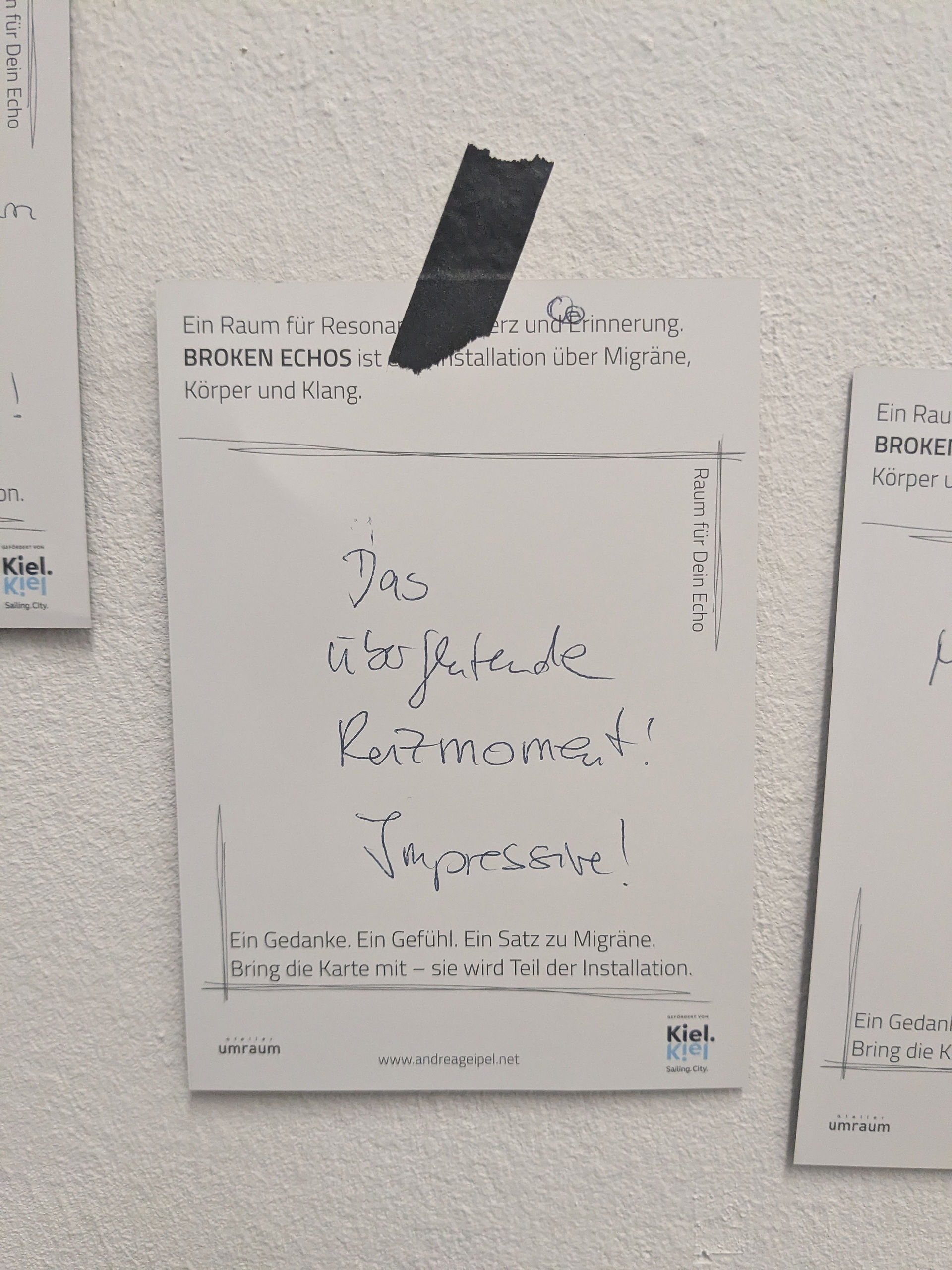
Twelve visitors left personal reflections on the walls. These included not only people with migraine, but also those without. The messages ranged from understanding and anger to gratitude and mutual support. These words perfectly encapsulate the dialogue I had hoped for: understanding, a shift in perspective, and shared experiences. And they brought home the realization of how invisible migraine remain in everyday life. These voices reinforced my desire to make migraine not only visible, but tangible – not as a medical explanation, but as a physical and emotional sensation. A space one enters and perhaps wants to leave too quickly.



Because invisible illnesses need spaces that make them visible. And BROKEN ECHOS was just the beginning for me.
Here's a link to BROKEN ECHOS in my portfolio. And you can find more information about BROKEN ECHOS in my first blog post .


Comments